What Is a Marketing Mix? A Founder's Guide to Your GTM Control Panel
Most B2B SaaS founders dismiss the term “marketing mix” as dusty academic theory. This is a critical error.
The marketing mix isn't a framework to memorize; it's the strategic control panel for your entire go-to-market motion, built around four core levers: Product, Price, Place, and Promotion. Mastering these levers isn’t about "doing marketing"—it's a fundamental GTM competency that separates the companies that scale from those that stall.
Stop Thinking In Frameworks, Start Thinking In Levers
Too many B2B SaaS leaders are trapped in tactical execution. They chase the latest growth hack, jump on a new channel, or copy-paste a playbook they read on LinkedIn. This tactical-first approach is a recipe for wasted growth motion.
It's why companies launch features no one asked for, set prices that kill adoption, or burn cash on ads in channels where their ideal customers simply aren't paying attention. This happens when you’re missing the strategic layer that connects all your actions.
The marketing mix is that strategic layer. It’s not a checklist; it’s a dynamic system of interconnected variables.
- Product: The actual solution you've built to solve a painful, specific problem.
- Price: What you charge, which is the clearest signal of the value you deliver.
- Place: Where and how customers find, buy, and access your product.
- Promotion: How you communicate your value to create awareness and drive demand.
Here’s the insight most teams miss: these aren't four separate workstreams. They are completely codependent. A change in one sends ripples across all the others.
Think about it. If you launch a new enterprise tier (Product), you can't just slap a higher price on it. That move dictates a new pricing model (Price), a different sales motion to support it (Place), and messaging that speaks directly to C-level buyers (Promotion). They all have to work in concert, or the entire strategy fails.

The Marketing Mix As A Strategic Control Panel
To make this operational, translate these levers into the core questions every B2B SaaS founder must answer. Each decision has direct strategic implications.
These aren't one-time questions. They are the dials on your GTM control panel that you must constantly monitor and adjust based on market feedback.
From Theory to Strategic Execution
Across dozens of early-stage and Series A-C companies, I’ve seen a clear pattern. The most successful leadership teams don't just "do marketing." They deliberately tune these four variables with precision because they understand the cause-and-effect relationships between them.
They know a low-friction, product-led growth motion (Product) is fundamentally incompatible with a high-touch, elephant-hunting enterprise sales team (Place). They recognize that a premium price point (Price) is dead on arrival without marketing materials that scream authority and build trust (Promotion).
This isn't gut instinct. It’s the disciplined application of the marketing mix model.
The marketing mix is your primary tool for resource allocation. It forces you to answer the most critical question in any startup: Given our finite time, money, and attention, where do we place our bets to achieve maximum impact?
Every successful SaaS launch—from landing your first 10 customers to scaling past $10M ARR—is a direct result of getting this mix right. It’s not about having a perfect strategy on day one. It's about having a mental model that allows you to diagnose what's broken, make informed adjustments, and continuously calibrate your GTM strategy. This isn't marketing fluff; it's how you win.
The Original 4Ps: The Unchanged Physics of Go-to-Market
B2B SaaS founders are wired to dismiss frameworks like the 4Ps—Product, Price, Place, and Promotion—as relics. This mistake costs companies dearly. These aren't concepts for selling soap; they represent the fundamental physics of bringing any solution to any market.
This isn’t academic theory. The “marketing mix” concept came from real-world consulting. In the 1950s, Harvard’s Neil Borden studied over 200 companies, proving how tweaking these core “ingredients” directly impacted sales. E. Jerome McCarthy later sharpened this into the memorable 4Ps in his 1960 book, Basic Marketing. By the 1970s, it drove strategy for 80% of Fortune 500 companies.
For a founder, this isn't a history lesson. It’s validation that these four levers have direct, causal links to your success. This is how you stop making decisions based on gut feel and start building a repeatable system for growth.
Product: The Solution to a High-Value Problem
In B2B SaaS, your product is not a bundle of features. It is the answer to a costly, urgent business problem. The most common failure I see is founders who fall in love with their tech instead of their customer’s problem.
Your job isn't deciding what to build; it's being ruthless about what not to build. It's about owning a specific problem space for a narrow ideal customer profile (ICP) so completely that your solution becomes non-negotiable for them.
Product isn't code. It's the entire experience: the onboarding flow that reveals value in minutes, the integration that saves a team ten hours a week, and the reliability that lets a CIO sleep at night. A weak product experience cannot be saved by strong promotion.
Price: The Loudest Signal of Value
Price isn't a number you set at the end. It is the most direct signal you send about your product's value and market position. Price too low, and you attract the wrong customers while signaling a lack of confidence. Price too high without justifying the value, and you create a gap your sales team will never close.
Pricing is one of your sharpest strategic tools. It dictates your business model, defines your target customer (SMB vs. enterprise), and shapes your GTM motion (PLG vs. sales-led). Your pricing tiers must be a thoughtfully designed journey, guiding customers from initial value to deep, expanded use. To get this right, you must understand how to define value-based pricing in a B2B SaaS context.
Place: Where Your Buyers Find and Access Value
For a SaaS company, "Place" is your distribution strategy. It’s the answer to a critical question: Where do my ideal buyers live online, and how will I get my solution in front of them?
- Product-Led Growth (PLG): The product is the channel. Place is your website, your freemium sign-up, and your app store listing.
- Sales-Led Growth: The sales team is the channel. Place is the outbound email sequence, the conference booth, and your partner ecosystem.
- Channel Sales: Your partners are the primary channel. Place is their marketplace, their consulting practice, and their co-selling motions.
Choosing the wrong "Place" is like opening a high-end boutique in an industrial park. You might have the best product in the world, but if your customers aren't there to find it, you don't have a business.
Promotion: How You Tell Your Story
Promotion is how you articulate your value to create demand. It’s not running ads; it’s the sum of all your communications.
This is your website copy, your sales deck, your content, and the talking points you arm your sales team with. For an early-stage founder, promotion is often just founder-led sales—telling the company story one-on-one until the message is so sharp it cuts through market noise. Strong promotion amplifies a clear signal; it cannot fix a weak one.
The 7Ps: The Necessary Evolution for B2B SaaS
The 4Ps provide the physics of go-to-market, but for a B2B SaaS company, they are insufficient. The original mix was designed for physical goods. For a business where the customer experience is the product, it leaves massive blind spots. A leaky revenue bucket isn't a promotion problem; it's an experience problem.
This isn’t an academic update; it’s a critical adaptation driven by market reality. As the services sector grew to constitute over 75% of GDP in major economies by the 1980s, the 4P model began to break down.
In 1981, researchers Booms and Bitner introduced three new levers—People, Process, and Physical Evidence—to address the gaps. This wasn't just theory. Early studies showed that service firms implementing the full 7Ps reported 40% higher customer satisfaction than those sticking to the old model.
This concept map shows the original 4Ps, which are still the core pillars of any go-to-market strategy.

While these four elements are foundational, they completely miss the service delivery components that make or break a modern SaaS business. Let's break down the other three.
People: The Human Layer of Your Product
For a SaaS company, your "People" are a living extension of your product. They are the sales engineers who make your solution click in a high-stakes demo. They are the customer success managers who turn a confused new user into a vocal power user. They are the support reps who solve a technical issue in minutes, not days.
I’ve seen high-churn companies obsess over feature velocity while ignoring the fact that their CSMs are undertrained and overworked. The result? A great product that customers can’t use, leading to frustration and churn.
Your people are not a cost center; they are the delivery mechanism for your product’s value. Their expertise and efficiency directly impact adoption, retention, and expansion revenue. This becomes even more critical as you move upmarket, where enterprise buyers are purchasing a relationship as much as they are a tool.
Process: The Architecture of Customer Experience
"Process" defines the operational reality of being your customer. It’s the sequence of steps a prospect takes from booking a demo to a successful, company-wide deployment. It is your onboarding flow, your ticketing and escalation procedure, and your quarterly business review cadence.
In B2B SaaS, a bad process feels like a bad product. A clunky, multi-step signup kills PLG momentum. A slow, manual implementation for an enterprise client erodes all the trust your sales team just spent months building.
I advise founders to map these critical paths relentlessly. Where is the friction? Where do users get stuck? Where do handoffs between your internal teams break down?
A well-designed process feels invisible to the customer—it just works. A broken one creates drag, frustration, and churn. Your process is the system that ensures value is delivered consistently and at scale.
Physical Evidence: The Tangible Signals of Trust
For an intangible product like software, "Physical Evidence" is every tangible clue you provide that proves you are a real, credible, and trustworthy partner. For a pre-revenue startup, this might be a sharp, well-reasoned pitch deck. For a growth-stage company, it's a SOC 2 Type II report.
It’s the polish on your UI and the clarity of your public-facing documentation. It’s the professional design of your website, the quality of your case studies, and the G2 reviews from real, named customers. These elements are not "marketing fluff." They are signals that answer the subconscious questions every buyer has:
- Is this company legitimate and stable?
- Do they take their product and security seriously?
- Can I trust them with my data and my business?
Ignoring these service-oriented Ps is a massive strategic blind spot. Founders who master the original 4Ps build a product and find a market. Founders who master all 7Ps build a durable, scalable business where the entire customer experience becomes a competitive advantage. This requires a deep understanding of your customer, something we explore in using buyer personas to accelerate B2B marketing and sales.
The Modern Mix: A Quantifiable System for Growth
Frameworks are theory. Growth requires accountability. For too long, founders have treated their marketing mix like an art form, driven by gut feel and vanity metrics. This is a direct path to a bloated marketing budget with zero accountability.
The modern marketing mix isn't a checklist—it's a quantifiable system. Its purpose is to answer one question: “Where should I invest my next dollar for the highest possible return?”
This means moving past simply listing the "Ps" and into the realm of measurement. The goal is to turn your go-to-market strategy into a predictable, optimizable engine by tying every single lever back to revenue.
The Shift to Marketing Mix Modeling
The idea of making marketing accountable isn't new. By the 1970s, Marketing Mix Modeling (MMM) started turning the 4Ps from an art into a science. Statisticians built regression models that could quantify the sales impact of each "P," with early tests showing ad spend alone could drive 15-25% sales lifts.
This shift allowed giants like Procter & Gamble to justify massive budgets, moving from guesswork to ROI-based precision. They achieved 20% efficiency gains even with models that took months to build. Today, the principles behind MMM are more accessible than ever, allowing even early-stage SaaS companies to adopt this data-driven mindset.
For B2B SaaS, this approach is non-negotiable. It’s about making every part of your mix pull its weight.
From Levers to Measurable Inputs
To build this quantifiable system, you must translate the 7Ps into measurable inputs. Your job is to connect specific activities to concrete revenue outcomes.
Product: Don’t just track feature releases. Measure how a new feature impacts activation rates, free-to-paid conversions, or expansion revenue.
Price: Stop guessing. A/B test your pricing tiers or value metrics and measure the effect on Annual Contract Value (ACV), churn, and sales cycle length.
Place: Don't just count partners. Track the actual pipeline they source, their close rates, and the LTV of customers acquired through each channel.
Promotion: Move beyond vanity metrics. Measure the cost per demo from your content, the pipeline influenced by a webinar, or the close rate on leads from a specific ad campaign.
People: Quantify your team's impact. Measure the time-to-value for customers onboarded by different CSMs or the demo-to-close rate of different sales reps.
Process: Track your customer journey's efficiency. Measure the conversion rate through your onboarding flow or the time it takes to resolve a support ticket.
Physical Evidence: Test the impact of your trust signals. Does adding a SOC 2 badge to your homepage increase demo requests? Measure it.
This isn’t about building a perfect model overnight. It's about instilling a culture of accountability where every significant investment is tied to a measurable hypothesis. Founders must understand how to calculate your marketing ROI for every dollar spent.
The goal is to create a direct feedback loop between your spending and your revenue. When you can confidently say, “Every dollar we put into X channel generates three dollars in pipeline,” you are no longer just doing marketing—you are systematically engineering growth.
This approach transforms the marketing mix from a static checklist into a dynamic dashboard for running your business. You can see which levers are working, which are broken, and where to allocate resources. For a deeper dive into connecting spend to results, check out our guide on how to measure marketing ROI specifically for B2B SaaS.
Common Failure Points: Where Founders Get the Mix Wrong
Theory is clean; execution is messy. I’ve worked with dozens of B2B SaaS companies, and I see the same strategic disconnects repeatedly. These aren't minor tactical mistakes—they're fundamental misalignments in the marketing mix that burn cash, exhaust teams, and kill momentum.
Think of these as a pre-mortem for your go-to-market strategy. Spotting these red flags in your own company is one of the most valuable exercises you can do.
The Price-Value Mismatch
This is the most frequent error I see. A founder builds a powerful product (Product) but, terrified of rejection, sets a timid price (Price). This attracts the wrong customers—those who demand heavy support, churn quickly, and offer feedback that pulls your roadmap in the wrong direction.
The opposite is just as dangerous. A startup with an unproven MVP sets an enterprise-level price, creating a value canyon their sales team can't cross. You end up with a stalled pipeline and a constant chorus of, "It's interesting, but not at that price." Your pricing must be a confident reflection of the value you deliver, not a reaction to the market.
Promoting an Unready Product
This is the classic case of putting the cart before the horse. A team launches a full-scale promotional campaign (Promotion) for a product that's still buggy, missing crucial features, or has a broken onboarding flow (Product and Process).
I once watched a company burn $50,000 on a launch campaign. It worked—they drove thousands of signups. The problem? The product’s core workflow was broken. They didn't acquire customers; they created a large, vocal group of detractors. That first impression was so negative it took them over a year to repair their reputation.
Remember: Promotion amplifies what you already have. If your product experience is flawed, you're just paying to advertise those flaws at scale.
Distribution in a Vacuum
This mistake happens when founders choose a distribution channel (Place) based on what’s trendy, not on where their Ideal Customer Profile (ICP) actually spends their time. I’ve seen teams building a complex data integration tool for CTOs try to go viral on TikTok. It’s a complete mismatch.
Another common scenario is forcing a sales-led motion (Place) to sell a product with a low annual contract value, making the unit economics unworkable. To get this right, you need to think about how all your channels work together. Many modern marketing mix strategies incorporate integrated marketing communication tactics to ensure your message is consistent wherever your buyers are. Your distribution has to align with your buyer’s world, not your own preferences.
Neglecting the Service Layers
Many technical founders obsess over Product and Price while ignoring the levers of People and Process. They build brilliant software but fail to invest in training their sales engineers (People) or designing a seamless implementation workflow (Process).
The result is a poor customer experience. Deals stall because demos are confusing. Customers churn because onboarding is a nightmare. In B2B SaaS, the customer experience is part of the product. Underinvesting in the people who deliver it and the processes that support it is a surefire way to create a leaky revenue bucket.
If you’re seeing high churn despite having a strong product, this is the first place you should look. It's critical to know how all these elements fit into the broader journey, a topic we explore in our guide to the product life cycle and marketing.
Auditing and Calibrating Your Marketing Mix
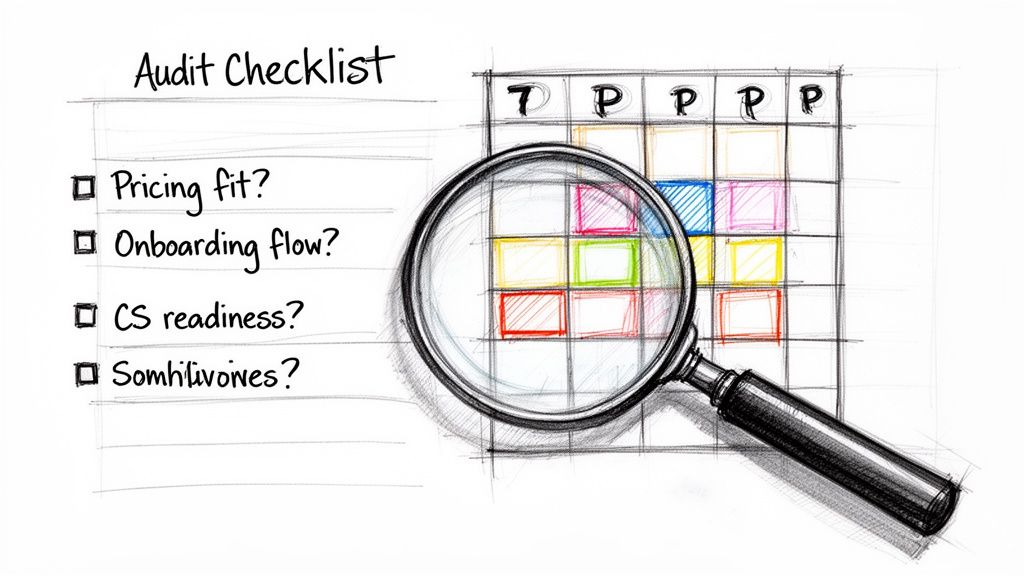
Knowing your marketing mix is one thing. Using it is another. The real value of the 7Ps framework isn't as a static model, but as a diagnostic tool for stress-testing your entire go-to-market strategy.
Think of it as a periodic, brutally honest physical for your business. It's how you stop guessing what's broken and start knowing exactly where to apply pressure.
Most founders avoid this kind of deep audit. They're too close to the product, too invested in a specific channel, or too afraid of what they might find. But you can't build a high-growth company on assumptions. You need clarity, and clarity demands you confront reality.
This audit isn’t about checking boxes. It’s about asking sharp, uncomfortable questions that get to the core of how your business really works.
The First-Principles Diagnostic
Use these questions to put your current marketing mix to the test. The objective isn't to find perfect answers—it's to pinpoint the most glaring disconnects that are leaking revenue and wasting your team's energy.
Product
- Does our roadmap directly solve the most expensive, painful problems our best customers have? Or are we building features that sound impressive in our boardrooms?
- Is our onboarding designed for a lightning-fast time-to-value? Or does it force customers into a high-effort, manual slog?
Price
- Does our pricing model truly reflect the value our most successful customers get? Or is it a reaction to our costs or a competitor’s pricing?
- Are our pricing tiers creating a clear, compelling upgrade path? Or are they a confusing mess that stalls deals?
Place
- Are we investing our time and money where our Ideal Customer Profile actively looks for solutions? Or are we just chasing the latest tactical trend on LinkedIn?
- Is our distribution model—PLG, sales-led, or hybrid—economically aligned with our average contract value (ACV)?
A brutally honest audit is the highest-leverage activity a leadership team can perform. It forces you to stop defending past decisions and start making better ones for the future. This is where you find the one or two critical adjustments that can completely change your growth trajectory.
Promotion
- Does our core message hammer home the painful problem we solve and our unique point of view on it? Or is it a generic laundry list of features and benefits?
- Are our promotional efforts generating qualified pipeline that turns into revenue? Or are we chasing vanity metrics like traffic and followers?
People
- Are our customer-facing teams—sales, success, support—trained and equipped to be credible experts? Do they embody our brand promise in every interaction?
- Do our hiring profiles match the skills needed to execute our GTM motion (e.g., technical sales for enterprise vs. community managers for PLG)?
Process
- Is our sales process meticulously designed to highlight our key differentiators? Or is it a generic demo that looks and sounds just like everyone else's?
- Where is the single biggest point of friction in our entire customer journey, from first touchpoint to renewal?
Physical Evidence
- Does every single touchpoint—from our website to our sales deck—signal credibility and reinforce our core positioning?
- What tangible proof (case studies, security certifications, G2 reviews) are we missing that our target buyers need before they'll trust us?
The answers to these questions become the blueprint for your growth strategy and spending. This audit shows you exactly where your assumptions are broken and what needs to be fixed now. The findings are the most critical inputs for your overall marketing budget planning for B2B SaaS startups.
Frequently Asked Questions
Let's tackle some of the tough, practical questions B2B SaaS leaders have when making the marketing mix work in the real world.
Is The Marketing Mix Relevant in a Digital-First PLG World?
Yes. It's more critical than ever. The marketing mix is a strategic model, not a tactical playbook. It's channel-agnostic. The core levers don't change, but how you pull them does.
For a Product-Led Growth (PLG) company, the mix shows up in different places:
- Place isn't your sales team's call list; it's your website, your in-app onboarding, and your listings on marketplaces like the Salesforce AppExchange or Atlassian Marketplace.
- Promotion isn't just running ads. It's baked into the design of your freemium offer, the viral loops you build into the product, and the SEO-driven content that fuels organic signups.
- Price is your entire tiering strategy. It’s the value metrics you choose—like users, contacts, or usage—that drive expansion revenue.
Ignoring the marketing mix in a PLG model is a massive strategic error. It's the framework that forces you to align your product, pricing, and promotion so they all work together to drive a low-friction customer acquisition engine.
How Often Should I Review My Company's Marketing Mix?
Your marketing mix is a living document, not a stone tablet. It needs two levels of attention.
First, continuous micro-adjustments. Your teams should be looking at performance data weekly. Is an ad campaign failing? Did a tweak to the onboarding flow boost activation? These are the tactical calibrations that keep the engine running.
Second, formal strategic audits. You must conduct a deep, formal audit of the entire mix at least quarterly. This is non-negotiable. You should also trigger an immediate audit anytime there's a major market event—a serious new competitor emerges, your growth flattens, or you're preparing for a major product launch.
This cadence maintains discipline and stops strategic drift before it kills momentum.
The most common failure I see is leadership teams treating their go-to-market strategy as a "set it and forget it" plan. The market moves too fast for that. A quarterly audit is the bare minimum for staying competitive.
Which of The 7Ps Is Most Important For an Early-Stage SaaS?
Product. Until you have a product that solves a real, painful problem for a very specific customer, nothing else matters. You can't promote, price, or distribute something that doesn't deliver core value. The other six Ps are almost completely irrelevant at this stage.
That said, Price and Place are a very close second, even at the beginning. As you hunt for your first ten customers, your initial pricing is your first real-world test of your value proposition. And your initial distribution channel—whether that's just founder-led outreach or posting in a niche community—is how you prove you can even reach the people you claim to serve.
At Big Moves Marketing, we help founders move beyond theory to build go-to-market strategies with this level of clarity. If you need a strategic partner to help you align your product, pricing, and positioning to accelerate revenue, visit https://www.bigmoves.marketing.
%20png%20copy.png)



%20-%20white.svg)