Improving Customer Lifetime Value Is a System, Not a Tactic
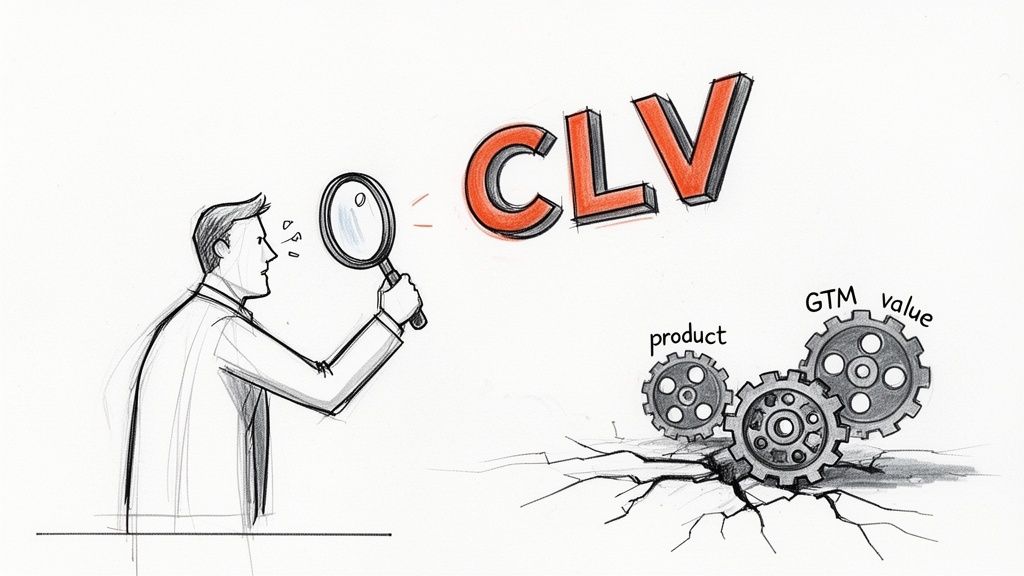
Improving customer lifetime value isn't about pulling tactical levers. CLV is a lagging indicator of your GTM strategy's health—it's the final score, not a play you can call on the field. It’s the direct output of your entire product, positioning, and go-to-market model working (or not working) in concert.
Most founders are told to obsess over CLV. This is flawed advice. Chasing the number with a grab-bag of disconnected tactics—a loyalty program here, a sudden price bump there—is a surefire way to waste resources. It ignores the systemic issues that dictate what a customer is actually worth to your business.
I’ve seen dozens of B2B SaaS companies fall into this trap, treating CLV as just another marketing KPI. It's not. It's a CEO-level diagnostic for the integrity of your entire business model. When that number is low, it’s a symptom of a much deeper problem.
Your CLV doesn't tell you what to do. It tells you to start asking better questions. Is our ICP wrong? Is the product failing to deliver on the sales promise? Is our onboarding a leaky bucket?
The typical playbook is to calculate a blended CLV and brainstorm ways to make it go up. This reactive motion leads to predictable failures:
- Wasted effort on low-impact customers: You burn cycles trying to "save" accounts that were never a good fit.
- Misaligned incentives: Sales closes deals that churn in three months, torpedoing your CLV while they cash commission checks.
- Product roadmap confusion: Product teams are pulled in a dozen directions by noisy, low-value feedback instead of focusing on features that create leverage for your best customers.
This superficial focus on the metric is why so many CLV initiatives fail. It’s like trying to raise your body temperature by holding a thermometer to a light bulb. You're manipulating the reading, not addressing the health of the system.
True improvement demands a first-principles look at your go-to-market and product strategy. This is also fundamental when you measure marketing ROI and its connection to customer acquisition and long-term value. This guide reframes CLV not as a metric to inflate, but as an output. We will expose the shallow thinking that leads to wasted growth cycles and provide a model for diagnosing the root causes of poor customer value.
Your Blended CLV Is a Lie
A single, blended Customer Lifetime Value for your entire customer base is worse than useless—it's dangerously misleading. It’s a vanity metric that actively hides the truth about your business.
This one number averages your best-fit, high-expansion accounts with the bad-fit, resource-draining customers who were never going to succeed. Relying on it is like a doctor averaging the body temperature of every patient in the hospital. The resulting number tells you nothing, masking the raging fever in one room and the critical hypothermia in another.
To make meaningful progress, you must kill the blended CLV. Your job is to dissect it.
From Vanity Metric to Diagnostic Tool
The only way to turn CLV into a metric that drives decisions is through strategic segmentation. This isn't about creating more dashboards; it's about forcing clarity. You must isolate the signal from the noise to see which customers represent the future of your company.
Most SaaS teams stop at surface-level firmographics—company size, industry, geography. This is a start, but it's lazy. It tells you who is buying, but not why they succeed or churn.
You must segment your customers by the pain that drove them to you and the specific job they hired your product to solve. Which use cases lead to high retention and expansion? Which lead to quick churn?
Answering this takes you from basic reporting into real cohort analysis. You group customers acquired in the same period and track their behavior over time. Did the cohort acquired after you launched that new onboarding flow have a higher CLV? Did a pricing change crush the CLV of your startup segment? This is where the real insights are.
For a deeper look at this process, our guide on strategic B2B customer segmentation provides a more detailed framework.
Actionable Segmentation Models for B2B SaaS
By shifting your perspective to the "Strategic Approach" column, you move from describing your customers to understanding what makes them successful. This is the foundation for any real CLV improvement.
Adapting RFM for SaaS Reality
A powerful, often overlooked model is adapting the e-commerce framework of Recency, Frequency, and Monetary (RFM) analysis for SaaS. The real power for a subscription business comes from adapting the first two principles:
- Recency: When was the last time this account showed meaningful engagement? This isn't just about logins. It's about value-driving actions within your product.
- Frequency: How often are they performing these key actions? Daily, weekly, monthly? High frequency indicates dependency and being embedded in their workflow.
- Monetary Value: Their current MRR or ARR, plus any expansion revenue.
Combining these factors reveals your true customer segments. It helps you identify high-value power users who deserve white-glove treatment and low-recency, at-risk accounts that need a targeted intervention. As detailed by experts at Cloudtalk, companies that master this can design precise retention strategies.
This isn't about complex data science. It's about asking sharper questions to diagnose where your product delivers the most value—and where it doesn't. Your blended CLV is a lie that encourages lazy thinking. Segmentation forces you to confront the truth about who you’re winning with and why.
The Three Levers of Real CLV Growth
Once you’ve moved past a blended CLV and segmented your customers, the path to real growth becomes clearer. It’s no longer about throwing a dozen disconnected tactics at the wall. It comes down to three systemic levers: Retention, Expansion, and Pricing.
Here’s where most teams get it wrong: they treat them as separate jobs. Customer Success owns retention, Sales chases expansion, and Finance sets the price. This siloed thinking is a massive failure because it misses how these forces work together. True CLV growth comes from orchestrating them as one cohesive strategy.
1. Retention: Win the First 90 Days
Generic advice like "focus on customer success" is not specific enough to be useful. The real battlefield for retention is won or lost in the first 90 days.
This is the window where you either prove the value you promised during the sales cycle or get exposed. A customer who stumbles through a confusing, low-value onboarding is already mentally churning, even if they don't cancel for another nine months.
Your single highest-leverage retention effort is to obsessively engineer a world-class onboarding process that gets customers to their first "aha" moment as fast as possible.
Stop asking, "How can we save at-risk accounts?" Start asking, "How do we prevent accounts from ever becoming at-risk?" The answer, almost every time, is found in those first 90 days.
2. Expansion: Build the Value Ladder
Expansion revenue is the ultimate health metric for a SaaS business, but it rarely happens by accident. You have to design for it. This means stop thinking of your product as a single tool and start seeing it as a value ladder.
Each tier, add-on, or new module should align with your customer's own growth. As they scale, hire more people, or face more complex challenges, your product must offer a clear, logical next step.
- Usage-Based Tiers: Let their pricing grow with their own success as they process more data or run more workflows.
- Feature-Based Tiers: Gate advanced features that only mature teams need in a higher tier that solves a more sophisticated set of problems.
- New Modules: Solve an adjacent problem for your best customers by building cross-sellable modules that make you even more essential.
When you think this way, account management transforms from a defensive function into a proactive growth engine. Your team isn't just "checking in"—they are guiding customers up the value ladder you intentionally built.
3. Pricing: Make a Statement About Value
The third and most powerful lever is pricing. Too many founders anchor their prices to competitors or internal costs. This is a massive, unforced error.
Pricing isn't a number on a page; it is the clearest articulation of the value you deliver. The ultimate driver of CLV is value-based pricing—tying what a customer pays directly to the economic value they receive from your product.
This shift forces a deep, unflinching understanding of the ROI your product creates. To go deeper on this, read our guide on how to define a value-based-pricing strategy. When you align price with value, revenue grows naturally as your customers succeed. This is the heart of net revenue retention and the engine of sustainable CLV growth.
This process chart shows how to connect your segmentation work to these three levers.
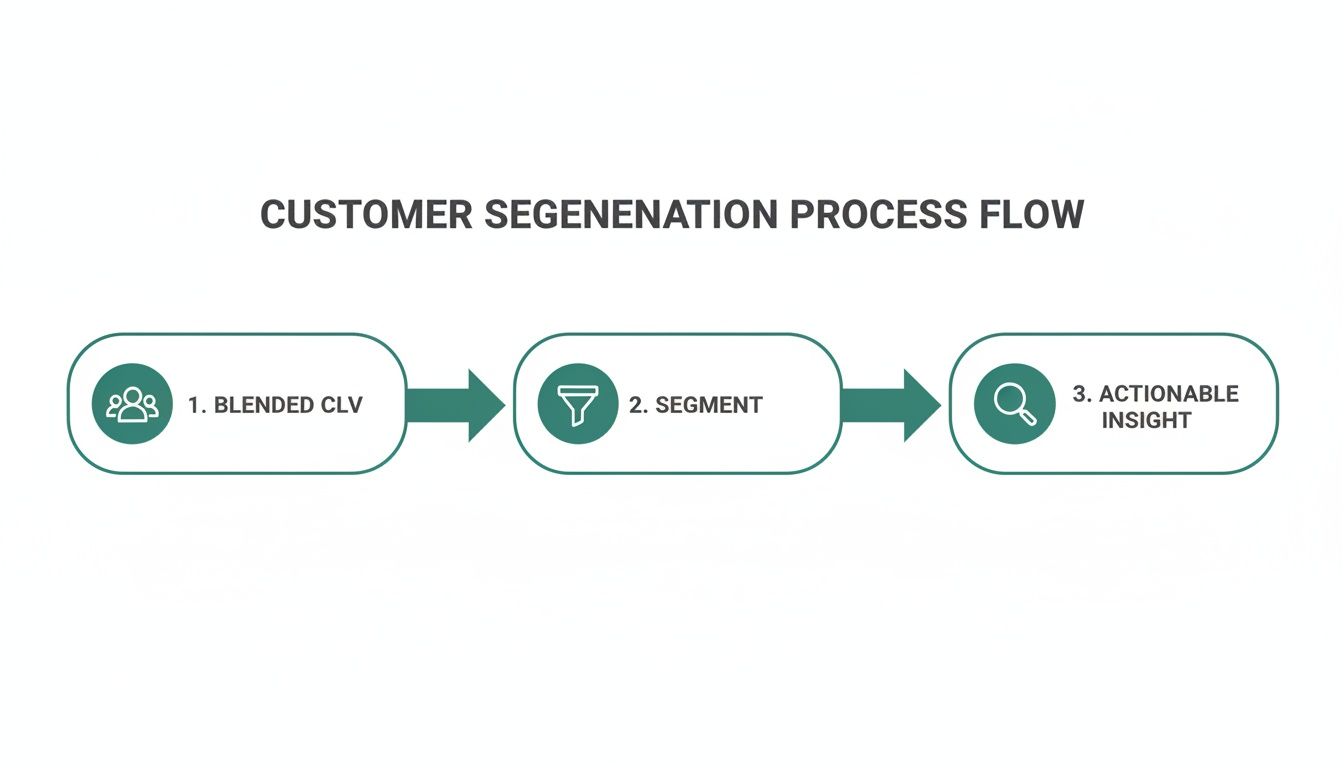
You can't pull the right lever for the right audience until you’ve filtered your customer base into meaningful segments. These three levers give you a clear framework for action. Instead of chasing a lagging indicator, you can focus your team’s efforts on the inputs that create durable, long-term customer value. To dive deeper into various methods for sustainable growth, consider exploring additional actionable strategies to increase customer lifetime value from other experts in the field.
Make Retention Everyone's Job
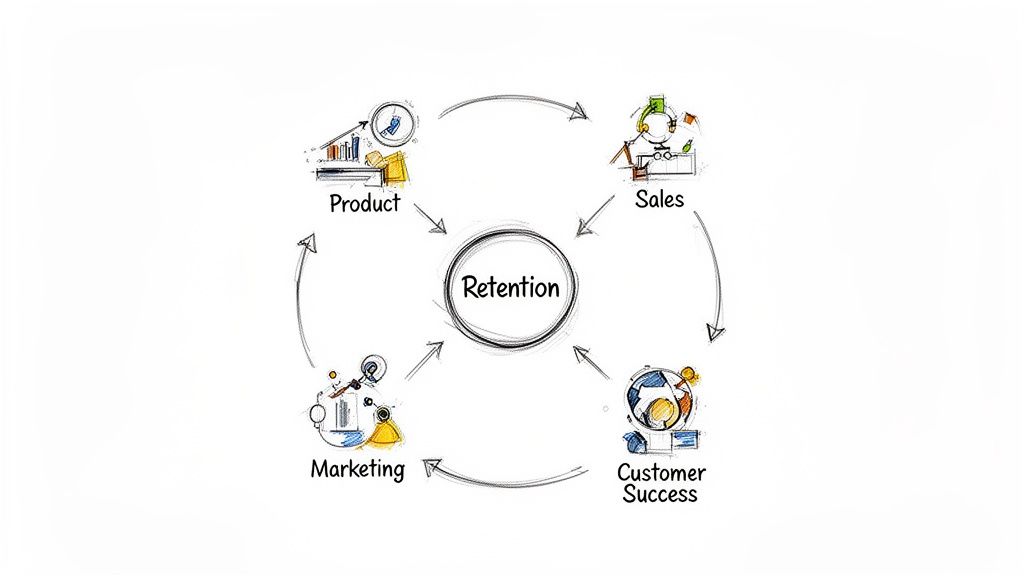
The biggest mistake in growth-stage SaaS is treating retention as a department, not an outcome. Siloing it inside the Customer Success team is a fatal strategic flaw.
When retention is solely CS's problem, you implicitly absolve the rest of the company of responsibility for a customer’s long-term success. The system you've built allows Sales to close bad-fit deals, Marketing to write checks the product can’t cash, and Product to build features that drift from your core value proposition.
This turns your CS team into a reactive fire department, scrambling to save accounts that were set up to fail. It’s not just inefficient; it’s a direct drag on your ability to scale. Improving customer lifetime value isn't about hiring more CSMs. It’s about re-engineering the organization so the entire business delivers on the promises made during the sales cycle.
Aligning Incentives Across Teams
Misaligned incentives are the root cause of most preventable churn. If you reward one team for actions that create cleanup work for another, you are sabotaging your own CLV. It’s time to ask hard questions about how your GTM and Product teams are measured and compensated.
Start with your sales compensation plan. If your Account Executives get full commission the moment a deal is signed, you are financially incentivizing them to close any deal, regardless of fit.
A deal that churns within the first 60 or 90 days isn't a win; it's a net loss. It consumes sales resources, onboarding capacity, and support time, only to damage your brand and depress morale when they leave.
Implement a commission clawback for any deal that churns within the first two quarters. This one change forces AEs to think like business owners, prioritizing good-fit customers who are likely to succeed. It aligns their financial interests with the long-term health of the company.
From Silos to Feedback Loops
Next, examine how information flows—or doesn't—between your teams. In most startups, customer feedback dies in departmental silos. A critical churn reason collected by CS never makes it to the product team's backlog, and a key insight from a lost deal is never reviewed by marketing.
This is a massive, unforced error. You're sitting on a goldmine of data that could prevent future churn, but it’s trapped. Your job is to build feedback loops that turn these disparate data points into a cohesive intelligence system.
Here are the specific feedback loops to build, starting today:
- Churn Surveys → Product Roadmap: Don't just ask, "Why did you leave?" Dig deeper. Was it a missing feature, a confusing UI, or a fundamental failure of your value proposition? This data should become a primary, heavily-weighted input for product prioritization.
- Sales Call Notes → Marketing Messaging: Your AEs hear raw, unfiltered objections and pain points every day. These notes are a treasure trove for your marketing team, revealing the exact language customers use and the competitive pressures they face. This is how you refine messaging to resonate with real-world problems.
- Support Tickets → Onboarding Flow: Are the same "how-to" questions clogging your support queue every week? That's not a support problem; it's an onboarding problem. It’s a clear signal your initial user experience is broken. Use this data to fix the product, not just to write another help doc.
Building a retention-focused culture is a deliberate act of organizational design. It moves your company from a reactive, "save this account" model to a proactive system engineered for customer success from the first touchpoint. Our guide on developing SaaS customer retention strategies explores exactly how to implement these systems. It’s about making retention everyone’s job—not just in name, but in practice.
Build Your Expansion Revenue Playbook
Expansion revenue is the clearest signal of a healthy SaaS business. Yet for most companies I’ve worked with, it’s treated as a happy accident—a welcome surprise, but not the output of a deliberate system. This is a massive strategic blind spot.
Relying on chance for expansion is no different than relying on inbound luck for new business. To shift from accidental revenue to a predictable growth engine, you must build a formal expansion playbook. This isn't about telling your Customer Success Managers to "upsell more." It's about engineering a process.
The goal is to move account management from a defensive posture to a proactive, revenue-driving function. That means arming your teams with the right data, messaging, and tools to systematically find, qualify, and close expansion opportunities.
Identify Expansion Triggers in Product Data
Your most powerful expansion leads aren't hiding in a CRM; they are signaling intent inside your product right now. Your first job is to translate product usage into commercial opportunity. Stop looking at vanity metrics like logins and start hunting for expansion triggers.
These are specific, quantifiable user behaviors that signal a customer is outgrowing their current plan or is ready for an adjacent solution.
What do these triggers look like?
- Approaching Usage Limits: A team consistently hitting 90% of their user seats, storage quota, or API call limits is screaming for an upgrade. This is the lowest-hanging fruit.
- Adopting "Expansion-Adjacent" Features: When a customer uses a free or basic version of a feature that has a more powerful, paid counterpart, they're a warm lead. If they create five basic reports, they are a prime candidate for your advanced analytics module.
- "Hacking" the Product: Are customers constantly exporting data to a spreadsheet to do something your product could do if they upgraded? This is a clear sign they have a job-to-be-done that you can solve with a higher-tier plan or add-on.
These triggers shouldn't be buried in an analytics dashboard. They need to be piped directly into your Salesforce or CS platform like Gainsight as automated alerts, prompting your team to act.
Arm Your Teams with Targeted Messaging
Once a trigger fires, your team needs to know exactly what to say. Generic "just checking in" emails are a waste of time. The outreach must be contextual and value-driven, speaking directly to the behavior you just saw.
This means building a library of modular sales and CS assets made specifically for expansion scenarios. This is not a one-size-fits-all pitch deck. It’s a toolkit.
The most common failure in expansion is sending a CSM into a commercial conversation with a support mindset. You must equip them with sales tools tailored for an existing, knowledgeable customer.
Your expansion playbook must include:
- Upgrade Pitch Decks: Short, focused decks that spell out the ROI of moving from one tier to the next. Think "Why Teams Like Yours Upgrade to Pro for Advanced Collaboration."
- Cross-Sell Battlecards: If you’re introducing a new module, build battlecards that explain the use case, ideal customer profile (within your own base), and how to position it against doing nothing or using a separate point solution.
- ROI Calculators: Simple tools that help a customer quantify the financial benefit of upgrading, based on their own usage data. Show them exactly how much time or money they will save by adopting the new functionality.
A well-structured onboarding process is the foundation for all future expansion. For more on this, check out our guide on customer onboarding best practices that set the stage for long-term growth.
Create a Repeatable Expansion Process
The final piece is to formalize the workflow. This turns one-off wins into a repeatable process that you can measure, optimize, and scale. It defines ownership and ensures opportunities don't fall through the cracks.
A solid expansion process looks like this:
- Trigger & Alert: A product usage event automatically creates an "Expansion Opportunity" in the CRM, assigned to the relevant Account Manager or CSM.
- Qualify & Research: The owner investigates the customer's account health, support tickets, and usage patterns to understand the context. Is this a healthy customer ready for more, or is the trigger a sign of frustration?
- Execute Play: Based on qualification, the owner deploys the right messaging play—a targeted email, a business review, or a feature demo.
- Track & Close: The opportunity is managed like any other deal in the sales pipeline, with clear stages and a forecast.
This system transforms your team's role. They are no longer servicing accounts; they are managing a portfolio of growth opportunities. Building this playbook is a core component of improving customer lifetime value because it turns your existing customer base into your most reliable source of new revenue.
Questions Founders Ask About CLV
When I talk with founders about CLV, the conversation cuts through the theory to the same handful of high-stakes questions. The standard advice often doesn't cut it. Here are direct answers to the most common ones.
How Often Should We Calculate CLV?
Annually is a vanity exercise. Quarterly is the right cadence for almost any growth-stage SaaS company.
Calculating CLV once a year is too slow to be useful. By the time you spot a worrying trend, you’ve lost twelve months. Monthly is often too noisy; you’ll overreact to statistical blips instead of identifying real patterns.
A quarterly review of cohort-based CLV hits the sweet spot. It's frequent enough to see the impact of a product release, pricing change, or new onboarding flow. This is the cadence that lets you ask the right strategic questions:
- Did the cohort we acquired after our new onboarding flow launched have a better 90-day retention rate?
- How did that Q2 pricing change affect expansion revenue from our mid-market customers?
- Is the payback period for customers from our new channel trending up or down?
Treat it like a strategic diagnostic, not a daily KPI.
What Is a Good CLV to CAC Ratio?
The ubiquitous 3:1 benchmark is a dangerously simplistic rule of thumb. The "right" ratio depends entirely on your company's stage and cash flow.
A well-funded startup in a land-grab for market share might tolerate a 1:1 ratio for a specific period, but only with a clear, data-backed path to improving CLV. A bootstrapped company can't afford that luxury and needs to aim for a much healthier 4:1 or 5:1 ratio.
A great CLV:CAC ratio is meaningless if your payback period is too long. A 5:1 ratio that takes 36 months to pay back is a cash flow disaster.
My advice to founders is to obsess over a payback period of under 12 months above all else. A fast payback period gives you the cash to reinvest in growth. Nail that first, then optimize for a higher long-term CLV ratio.
Retention or Acquisition First?
This is a false choice, but one that founders constantly wrestle with. In the very early days, you need both. But a "growth at all costs" mindset is a trap if your product is a leaky bucket.
Here’s my non-negotiable rule for founders: Until your Net Revenue Retention (NRR) is consistently over 100%, a significant portion of your focus must be on retention.
Pouring more leads into a product that doesn't retain and expand customers is an expensive way to burn cash and damage your reputation. Fix the bucket first. Of course, getting these numbers right means understanding the basics, including how to calculate customer lifetime value to begin with. Once you have a proven model for keeping and growing your ideal customers, you've earned the right to aggressively scale acquisition.
At Big Moves Marketing, we help founders move beyond vanity metrics and build the strategic clarity needed to drive sustainable growth. If you're ready to stop chasing numbers and start engineering a system for durable customer value, let’s connect. Learn more at https://www.bigmoves.marketing.
%20png%20copy.png)


%20-%20white.svg)