%20png%20copy.avif)

Published on: bigmoves.marketing/blog | Category: AI in Marketing, B2B Marketing Strategy
There is a moment in every major technology shift when the conversation stops being about whether to adopt and starts being about how well you are using it. For AI in marketing, that moment is now.
In 2026, 96% of B2B marketers report using AI in their roles, according to Demand Gen Report's 2026 B2B Trends Research Report. Nearly half of them rank it as the single trend they are most excited about. The AI marketing market — valued at approximately $57.99 billion in 2026 — is on a trajectory to reach $240 billion by 2030, growing at a CAGR of 37.2%.
But here is the challenge that sits underneath these headline figures: adoption does not equal advantage. Only 6% of organisations qualify as "high performers" where AI contributes meaningfully to bottom-line results. Most B2B marketing teams are stuck in the experimentation phase, running point solutions and one-off use cases, while a smaller group of practitioners builds compounding, systemic advantages.
The next chapter of AI in marketing is going to be defined not by who uses the tools, but by who understands where the technology is heading — and builds for that future now.
This article brings together the most important signals, data, and emerging patterns across B2B marketing to present five high-confidence predictions for 2026 and the years beyond. Whether you are a B2B startup founder, a fractional CMO, a product marketer, or part of an enterprise marketing and sales team, these predictions will help you prioritise where to invest your attention, budget, and capability building.
For B2B marketing in 2026, dozens of emerging trends were screened through strict criteria to prioritize what matters for revenue-generating teams, rather than what is merely popular in tech media.
Our selection framework prioritised four factors:
Cross-source consistency: A trend needed to appear across at least three independent, high-authority sources (analyst firms, peer-reviewed research, or large-scale industry surveys) before we considered it validated. Single-source vendor claims were excluded unless corroborated by buyer data.
Observable adoption signals: We looked for evidence of real deployment, not just hype. Predictions included here are backed by usage statistics, production-case studies, or platform integrations that are already live in enterprise environments.
Buyer-behaviour impact: The strongest 2026 trends are those changing how B2B buyers behave, not just how marketers produce content. If a trend shifts where buyers research, how they evaluate vendors, or what they expect from personalised experiences, it meaningfully changes buying decisions.
Near-term relevance: We excluded flashy but low-adoption use cases and vendor-led claims without corroboration. Our focus is on changes that will affect B2B go-to-market decisions over the next 12 to 24 months, not speculative scenarios five years out.
This methodology ensures that each prediction represents a structural shift in B2B marketing, not a temporary tactical opportunity.
Before we get into the predictions, it is worth understanding why 2026 feels different from previous years of AI hype.
For the past three years, the dominant pattern in AI adoption has been task-level automation: teams using AI to write faster, generate image variants, summarise research, or personalise email subject lines. Useful, certainly, but incremental.
What is happening in 2026 is something qualitatively different. AI is moving from assisting human decisions to operating independently within complex workflows. The technology is embedding itself into the infrastructure of marketing — into the CRM, the content pipeline, the search ecosystem, the buyer's decision-making journey, and the performance measurement layer.
61% of marketers believe marketing is experiencing its biggest disruption in 20 years due to AI, according to HubSpot's 2026 State of Marketing Report. That is a striking claim from professionals who have lived through mobile-first, social media, inbound marketing, account-based marketing, and GDPR.
What makes it credible is the convergence happening across several fronts at once: agentic systems, generative search, hyper-personalisation at scale, LLM-mediated buyer journeys, and the rising premium on authentic brand voice. These are not isolated trends. They are interconnected, and they are all accelerating simultaneously.
Here are the five predictions that matter most for B2B marketers in 2026 and beyond.
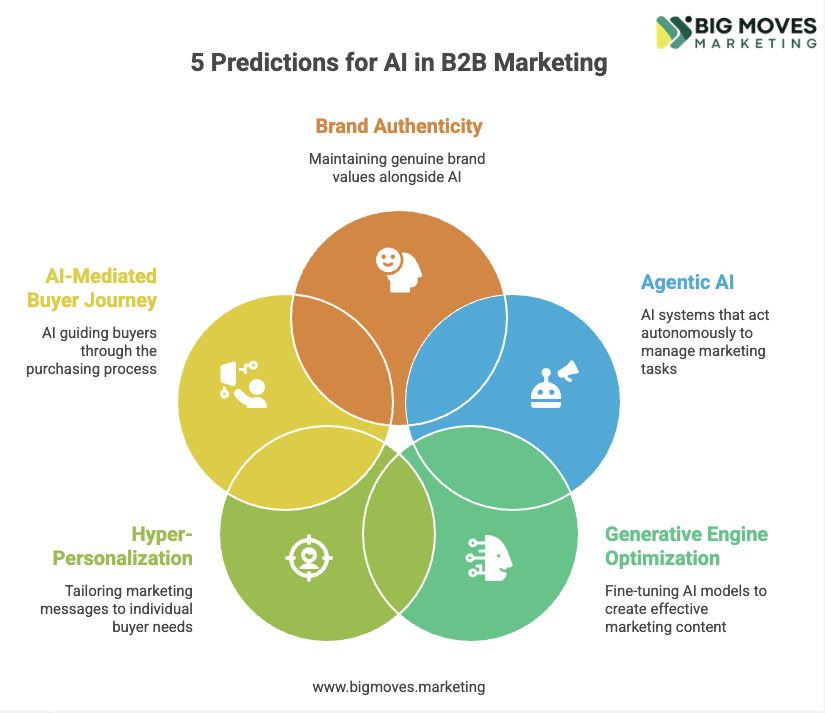
AI in Marketing: 5 Predictions for B2B Marketing in 2026 and Beyond
If 2024 was the year of the AI assistant and 2025 was the year of the AI copilot, 2026 is the year of the AI agent — and the shift is as significant as that framing suggests.
Agentic AI refers to systems that do not just respond to prompts but independently plan, reason, make decisions, and take action. They are not waiting for a human to ask a question. They monitor conditions, identify opportunities, execute tasks, and optimise outcomes — autonomously and continuously.
Gartner predicts that 40% of enterprise applications will include task-specific AI agents by the end of 2026, up from less than 5% in 2025. IDC forecasts that by 2026, AI copilots will be embedded in nearly 80% of enterprise workplace applications. And Gartner has also predicted that by 2028, 60% of brands will use agentic AI to facilitate streamlined one-to-one interactions.
For B2B marketing teams specifically, agentic AI is reshaping operations across three interconnected layers.

Prediction 1: Agentic AI Becomes the New Marketing Operating System
At the operations level, agents are handling the structural work that previously consumed significant human time: keyword monitoring, competitive analysis, content briefing, campaign performance tracking, budget reallocation, A/B testing, and reporting. Think of it as reclaiming the 70% of marketing work that is important but not strategic. Autonomous campaign orchestration means AI agents continuously monitor performance across channels, identify optimisation opportunities, and implement changes — all while respecting brand guidelines.
For account-based marketing specifically, multi-agent orchestration is enabling something that was previously impossible at scale: one agent identifies buying committee members, a second researches the account's current priorities and challenges, a third generates personalised outreach, and a fourth monitors engagement to trigger follow-up sequences — all running in parallel, continuously, across hundreds of target accounts simultaneously.
AI SDRs, intelligent chat experiences, and dynamic content delivery systems are moving from pilot stages to production infrastructure. 57% of companies already have AI agents in production, with more than half reporting they are highly likely to expand scope or budget over the next 12 months, according to G2's 2026 Agentic AI research.
The practical implication for B2B companies: the website is no longer a passive content destination. It is becoming an active, intelligent presence that engages prospects in real time, personalises the experience based on firmographics and behavioural signals, and advances deals autonomously. B2B buyers are already penalising brands with poor digital experiences, according to Gartner's Philip Black — and the digital experience is now considered as important as the sales rep.
This is perhaps the most consequential development for B2B marketers to internalise. Your buyers are increasingly using their own AI agents to research vendors, compare options, shortlist providers, and in some cases initiate procurement conversations. Forrester predicts that 1 in 5 sellers will need to respond to AI-powered buyer agents with dynamically delivered counteroffers via seller-controlled agents.
The two imperatives that will determine whether brands win or lose in this environment are discoverability, the ability to be found by the agents that mediate discovery, and desirability, the power to be wanted by the consumers those agents serve (BCG has articulated). Your marketing must now work for AI intermediaries, not just human decision-makers.
Start with an honest audit of your current manual bottlenecks. Which tasks consume the most time but require the least strategic judgement? That is where your first agent deployment belongs. Build in human oversight at every high-stakes checkpoint — agent programmes maintaining human oversight are twice as likely to achieve cost savings of 75% or more compared to fully autonomous setups. And prepare your data infrastructure first: the four most common deployment mistakes are building in-house instead of using proven platforms, automating too many processes at once, neglecting data readiness, and failing to manage agents after deployment.
Agentic AI in practice: Across current B2B deployments, the most effective teams are not the ones automating everything. They are the ones using agents for repetitive signal collection and account scoring, while keeping humans firmly in the loop for outreach personalisation and relationship-building. Agentic workflows are useful when they handle the "searching" and "summarising," but they falter when asked to replicate the nuance of human empathy. Don't automate the trust-building moments.
Here is a question that every B2B marketer should be asking in 2026: when a potential buyer asks ChatGPT, Perplexity, Google Gemini, or Microsoft Copilot to recommend solutions in your category, does your brand appear in the answer?
If you have not yet audited this, the answer is likely: not consistently, or not at all.
The rapid adoption of AI-powered search is dismantling the assumptions that have underpinned B2B content and SEO strategy for the past decade. Traditional search volume is predicted to decline 25% by 2026, as users migrate to conversational AI tools that surface synthesised answers rather than lists of links. When an AI summary appears in Google results, users click traditional links only 8% of the time, compared to 15% without AI summaries. 60% of Google searches already result in zero clicks.
At the same time, AI-referred sessions jumped 527% year-over-year in the first five months of 2025, according to Previsible's AI Traffic Report. This traffic is both growing and highly valuable. AI search visitors convert 4.4 times better than standard organic visitors in B2B environments, according to Omni Marketing's 2026 Traffic Report.
In response to this shift, a new discipline has emerged: Generative Engine Optimisation (GEO) — also referred to as Answer Engine Optimisation (AEO) or AI Visibility Optimisation. GEO is the practice of structuring and optimising content so that AI-powered search platforms cite, reference, or recommend that content in their generated answers.
By mid-2026, every marketing team will track how often their brand appears in AI-generated answers, just as they track web traffic and search rankings today, according to Brandi AI's trend report. GEO is moving from an emerging tactic to a core discipline that sits alongside SEO in the B2B marketing stack.

Prediction 2: Generative Engine Optimisation Becomes a Core B2B Marketing Discipline
For B2B companies, producing content is no longer enough. The question is no longer "does this rank?" but "will an AI system cite this?"
The difference comes down to credibility signals. AI systems are trained to prioritise sources that demonstrate authority, corroboration, and third-party validation. Here is what that looks like in practice:
Analyst validation: Coverage from Gartner, Forrester, and IDC carries significant weight. When your category is discussed in analyst reports, AI models are more likely to surface your brand as a credible option.
Review-platform consistency: A strong, consistent presence on G2, Capterra, and Trustpilot signals market legitimacy. AI systems cross-reference review volumes and ratings to assess which vendors buyers trust.
Expert commentary: Original analysis, expert bylines, and substantiated claims from recognised industry voices help differentiate citable content from generic AI-generated material.
Corroboration across sources: When your brand appears across owned channels (blog, case studies), third-party publications (LinkedIn, Reddit, industry media), and review platforms, AI systems treat the brand as verified rather than self-promotional.
The practical role of sources like Reddit, LinkedIn, and review platforms cannot be overstated. B2B buyers show 90% click-through rates on AI Overview sources, compared to 8% for general users. When a buyer is investigating vendors for a significant purchase, they follow the sources AI surfaces — and those sources are increasingly community-driven and peer-validated.
To build a citable B2B brand, we recommend starting your GEO audit with these four areas:
For a deeper technical breakdown of GEO implementation, MyMentions's site offers a practical guide for 2026 that complements this strategic overview.
For B2B marketers, executing effectively on GEO involves a meaningful evolution in how content is created and distributed. The distinction from traditional SEO is material:
B2B buyers show 90% click-through rates on AI Overview sources, compared to 8% for general users. This reflects the research-intensive nature of B2B buying: when a buyer is investigating vendors with a $150,000 or $1.5 million purchase in mind, they follow the sources AI surfaces. Being cited is not just a visibility metric — it is a pipeline metric.
Brands that produce 12 new or optimised pieces of digital content achieve up to 200x faster visibility gains in AI answers than those producing just four, according to Brandi AI's data. The recency signal matters significantly: 50% of content cited in AI search responses is less than 13 weeks old, according to research by Amsive. This means content freshness, which was always important for SEO, is now even more critical for AI visibility.
The structural requirements for GEO-ready content include: higher information density per paragraph, structured data deployment (FAQ schema, HowTo schema), direct answer blocks that work as standalone extracts, and multi-source brand corroboration across owned and third-party channels. On the off-site side, building genuine authority in industry publications, analyst coverage, and community platforms (LinkedIn, Reddit, Quora) provides the credibility signals that AI systems use to decide what to cite.
Importantly, GEO does not replace SEO — it extends it. Your existing SEO foundation (technical site health, topical authority, domain credibility) directly supports your GEO performance. The shift is in emphasis: from ranking pages to earning AI citations. Both matter, and the brands that will thrive are those that combine both, building the foundation with technical SEO and earning AI citations through a dedicated GEO strategy.
For years, "personalisation at scale" has been a promise that the marketing industry aspired to but rarely delivered on in B2B contexts. The technical complexity of mapping thousands of individual buying journeys, the data quality challenges of fragmented CRMs and marketing automation platforms, and the sheer creative volume required to produce personalised content made achieving it impractical.
In 2026, agentic AI is making that aspiration achievable for the first time at B2B scale, and as a result, 73% of B2B buyers now expect highly personalised experiences. What was once a differentiator is becoming a baseline expectation.
The data on impact is compelling. AI-driven campaigns deliver an average 22% higher ROI, with 32% more conversions and 29% lower acquisition costs than traditional methods, according to analyses by Zebracat AI and McKinsey. Marketers who embed AI and data into their strategy report an average of 13% higher revenue and 13% lower costs. AI personalisation tools produce an average 20% lift in conversion rates.
For enterprise sales forecasting specifically, the improvement is dramatic: AI achieves 79% accuracy compared to 51% using traditional methods. High-performing sales teams using AI are 10.5 times more likely to see major improvements in forecast accuracy.

Prediction 3: AI-Driven Hyper-Personalisation Becomes the B2B Baseline
By 2026, AI personalisation in B2B marketing is shifting from a content-production experiment into a core customer-experience investment. Adobe's 2026 B2B journey research reports that 59% of B2B organizations identify more personalized customer experiences as their top AI investment goal for the next 18 months. That ambition reflects a significant gap between what companies want to deliver and what many currently operate: Adobe's earlier benchmark found that only 36% of organizations used data and algorithms to customize web experiences, while just 35% made recommendations based on previous behavior.
Agentic AI is closing that gap by turning scattered behavioral data into usable intent signals. But here is the critical distinction: intent data should be treated as a prioritization system, not proof that an account is ready to buy. A 2026 buyer-intent benchmark cited by OmniBound reports that only 26% of intent signals convert into qualified opportunities, based on a DemandScience study of 750 respondents conducted in October 2025. This statistic is useful because it challenges the common assumption that a page visit, content download, keyword search, or surge in account activity automatically represents buying intent. Instead, it signals that a buying-group discussion is underway — and that is when personalised outreach matters most.
The practical implication for B2B marketers is a shift from reactive personalisation (responding to individual actions) to proactive account prioritisation (identifying accounts where buying signals cluster and preparing custom experiences before the first touch).
Account-based personalisation moves beyond lead-level tactics to address the entire buying group within a target account. Here is how the framework works in practice:
Intent spike detected: Agentic systems identify a cluster of signals — multiple stakeholders visiting pricing pages, job changes in key roles, relevant content downloads, and increased social engagement — that suggest a buying window is opening.
Buying committee mapped: The system identifies who is involved in the decision (economic buyer, technical evaluator, end user, champion) and what each stakeholder cares about.
Industry-specific proof surfaced: Relevant case studies, ROI data, and compliance information are matched to the account's industry, company size, and specific challenges.
Outreach and landing page adapted: Personalised outreach references the account's context, and the landing page experience shifts to address the specific concerns of each stakeholder role.
This approach requires a different content strategy than one-to-one personalisation. Instead of creating hundreds of individual variations, you build modular content blocks — industry proofs, role-specific benefits, technical specifications — that can be assembled dynamically based on the account profile.
The teams that will execute this most effectively are those that invest in well-defined data architecture, clear account-scoring frameworks, and governance rules that ensure AI-generated personalisation maintains brand consistency and human authenticity.
The B2B buying journey in 2026 is now characterised by remarkable complexity: the average journey lasts 272 days and involves 88 touchpoints, four channels, and ten stakeholders. AI personalisation in this environment is not just about putting someone's first name in an email subject line. It is about:
The buying cycle is also compressing. B2B buying cycles have shortened from 11.3 months to 10.1 months with AI adoption — partly because buyers come to conversations more informed, and partly because AI-enabled sales and marketing teams respond more quickly to buying signals.
The most important qualification on this prediction is that AI-driven personalisation creates real risks if pursued without intentional design. 94% of B2B buyers finalise vendor preferences before direct interaction with a sales team — meaning the experience a buyer has with your automated, AI-driven touchpoints will form a significant part of their impression before any human ever enters the conversation.
If personalisation feels mechanical — if the relevance feels accidental rather than considered — it can undermine trust rather than build it. 80% of consumers now expect AI interactions to reflect empathy and brand tone, not just efficiency. For B2B buyers, who are making high-stakes decisions under professional scrutiny, authenticity in communication carries significant weight.
The teams that will execute personalisation at scale most effectively are those that invest in well-defined brand guidelines that their AI systems can operate within, quality-tested content that reflects genuine expertise, and governance frameworks that ensure AI-generated touchpoints meet the same standards as human-created ones.
This prediction sits at the intersection of Prediction 1 (agentic AI) and Prediction 2 (GEO), but it deserves its own framing because the implications for B2B marketing and sales teams are so specific and so urgent.
94% of B2B buyers used large language models during their buying journey in 2025, according to research from 6sense. This is not a fringe behaviour. It is the norm. When your potential buyers have a challenge to solve or a category to evaluate, they are increasingly beginning that research with a conversation with ChatGPT, Gemini, Claude, or Perplexity — not with a Google search and certainly not by clicking on a display ad.
This creates a structural challenge that many B2B marketing teams have not fully reckoned with: if your brand is not visible in AI-generated answers during the research phase, you are being excluded from consideration before you even know the buyer exists. The age of AI discoverability will shift B2B marketing strategy from building awareness through budget and keywords to building a credibility-driven reputation across the public internet.
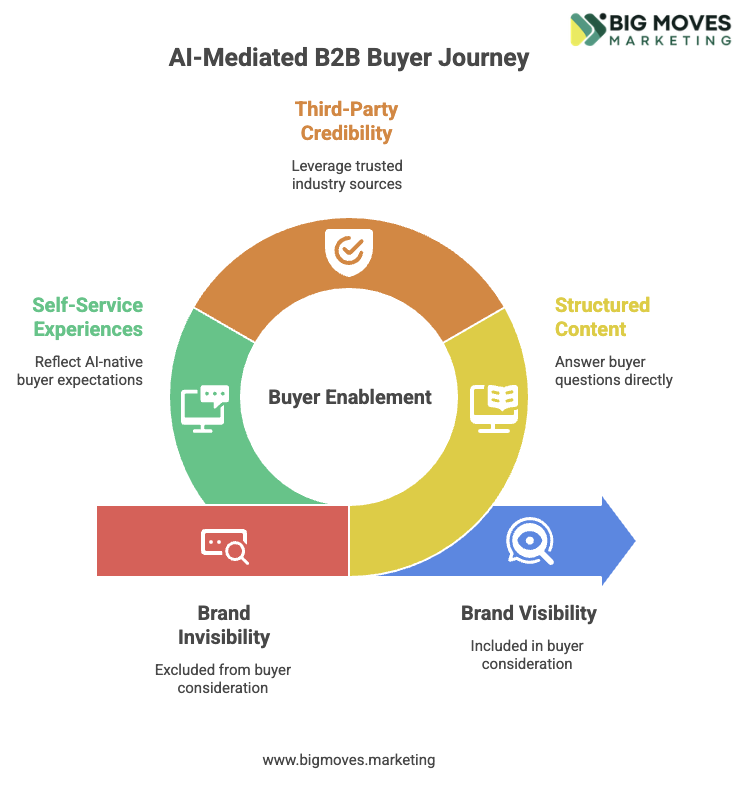
Prediction 4: The B2B Buyer Journey Becomes AI-Mediated
The concept of buyer enablement — creating the content, tools, and experiences that help buyers make confident decisions — has moved from a best practice to a competitive differentiator that Gartner describes as the single most important trend reshaping B2B marketing in 2026. B2B buyers are penalising brands with poor buyer enablement. And the digital experience now carries as much weight with buyers as the sales rep.
What does genuine buyer enablement look like in an AI-mediated world?
Structured, answer-ready content: Your content needs to directly and clearly answer the questions buyers are asking their AI tools. This means moving beyond thought leadership that is interesting but vague, toward content that is specific, structured, and information-dense. Think: comparison frameworks, decision criteria guides, ROI calculators, technical implementation breakdowns, and honest competitive analyses.
Third-party credibility signals: AI systems weight third-party sources heavily. AI engines exhibit strong citation bias toward trusted industry publications. For B2B companies, this means analyst coverage, G2 reviews, industry association content, earned press coverage, and peer-to-peer review platforms are now part of your organic visibility strategy, not just your reputation management programme.
Faster, more capable self-service experiences: 58% of B2B buyers consider AI capabilities a key evaluation factor when assessing vendors. The implication is that how well your own products and platforms incorporate AI is itself becoming a buying criterion. Your website, demo environments, and onboarding experience all need to reflect the AI-native expectations buyers now bring.
The AI-mediated buyer journey also has significant implications for how sales and marketing teams coordinate. With nearly half of all B2B transactions over $1M already moving through digital channels, the handoff model — where marketing generates awareness and then passes leads to sales — is giving way to a more integrated, technology-enabled model where AI agents handle early-stage qualification and education, and human sellers engage at the moments of genuine complexity and trust-building.
For B2B SaaS companies and enterprise software vendors in particular, this means investing heavily in the content and infrastructure that enables buyers to self-educate before any sales conversation, and creating AI-mediated sales tools that allow your team to engage more precisely when buyers are ready.
Of all five predictions, this is the one that carries the greatest strategic implication for B2B teams who are tempted to automate everything.
As AI democratises execution — content production, campaign deployment, data analysis, personalised outreach — the inputs that AI cannot manufacture become increasingly valuable. Chief among them: a genuine, distinctive brand point of view; original research and proprietary data; authentic human expertise; and creative originality that reflects real experience.

Today, more content is generated by AI than by humans. But most of it is average. Audiences are developing an acute sensitivity to AI-generated content that lacks genuine perspective. Content is moving to gated spaces that AI has not overrun — newsletters, podcasts, YouTube channels, LinkedIn thought leadership, and community-based content — spaces where human presence and voice are the implicit value proposition.
The signal is equally clear from the demand side. AI has flooded the market with content, and brands without a clear point of view are getting lost. As AI content floods the web, trust in AI outputs remains low — only 4% of marketers express high confidence in AI outputs. The buyers who read your content, evaluate your brand, and ultimately make purchasing decisions are humans. And humans are extraordinarily good at detecting authenticity — or its absence.
The B2B marketing teams that will perform best in the next three to five years are not those that automate the most aggressively, but those that use AI to amplify what is human and distinctive about their organisation.
Practically, this looks like:
Your point of view on your market, your category, and your buyers' challenges is something AI cannot synthesise. Invest in clear editorial standards that define what your brand believes, how it communicates, and what it will not say. Use AI to execute in that voice — but do not outsource the voice itself.
The content that AI systems cite most reliably, and that B2B buyers trust most, is content grounded in original data. Industry surveys, benchmark reports, customer research, and original analysis create assets that AI-generated content cannot replicate, because the data does not exist anywhere else. These are also the assets most likely to earn the third-party citations that drive GEO performance.
The role of the human marketer is evolving from execution toward strategic orchestration: defining the unique narrative that AI cannot fabricate, exercising judgement about what data means, and building the genuine relationships and credibility that authoritative brands earn over time. LinkedIn thought leadership, executive visibility, podcast appearances, keynote presentations, and substantive industry writing all become more valuable as AI-generated content becomes more prevalent — because they are clearly human, credibly specific, and difficult to replicate.
In 2026, growth is increasingly driven by distinctiveness, trust, and relevance. Short-term performance metrics will not tell this story adequately — you need to track brand perception, share of voice in AI-generated answers, and the depth of buyer trust that your content and communications build over time.
The most effective B2B marketing in 2026 and beyond is not human versus AI — it is human plus AI, with each doing what it does best. AI handles the structural, the repetitive, the data-intensive, and the scalable. Humans handle the strategic, the creative, the empathetic, and the authentic. Audiences reward brands that feel authentic, helpful, and human. The teams that internalise this and design their marketing operations accordingly will build advantages that pure automation cannot achieve.
Reading these predictions together, a clear pattern emerges: the B2B marketing teams that will win in this environment are those that invest in the infrastructure for AI-powered marketing, not just the tools.
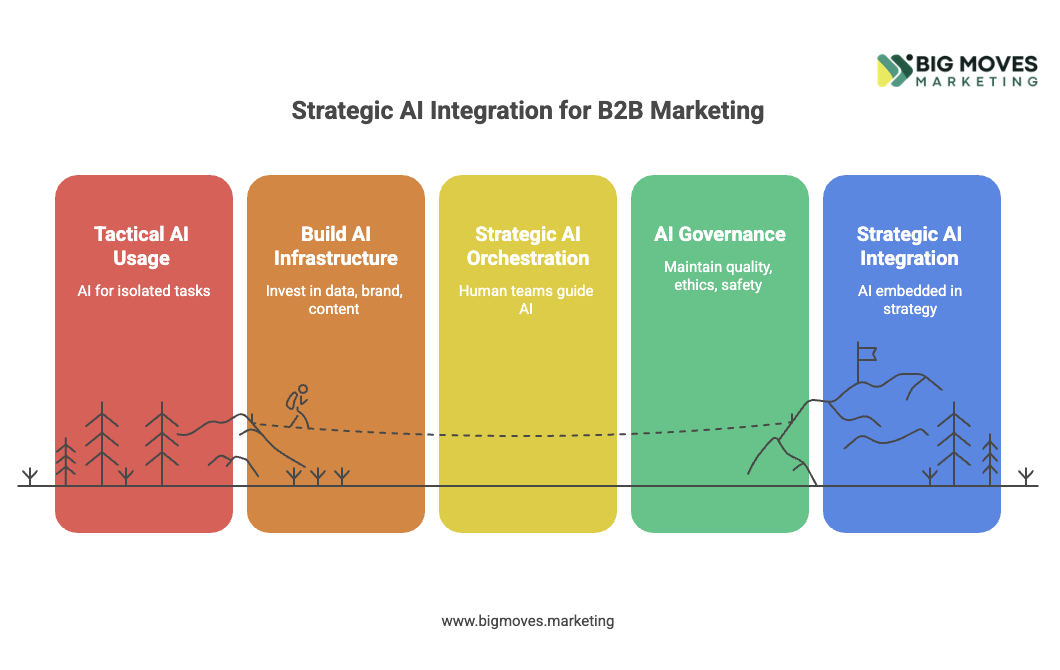
Strategic integration of AI in B2B Marketing
That infrastructure includes:
Embedding AI into strategy — not just tasks — delivers an average of 13% revenue growth and 13% cost savings. That is the difference between using AI tactically and building for it strategically.
The encouraging reality for B2B teams at any stage, from early-stage SaaS startups to enterprise companies, is that this transition rewards clarity of focus over scale of budget. A startup with a distinctive point of view, excellent structured content, and an honest GEO strategy can outperform a much larger competitor that is generating high volumes of undifferentiated AI content. The playing field is being levelled in ways that favour strategic intelligence over resource volume.
Drawing together the five predictions, here is a practical framework for where to focus your attention and investment in the next 12 to 24 months.
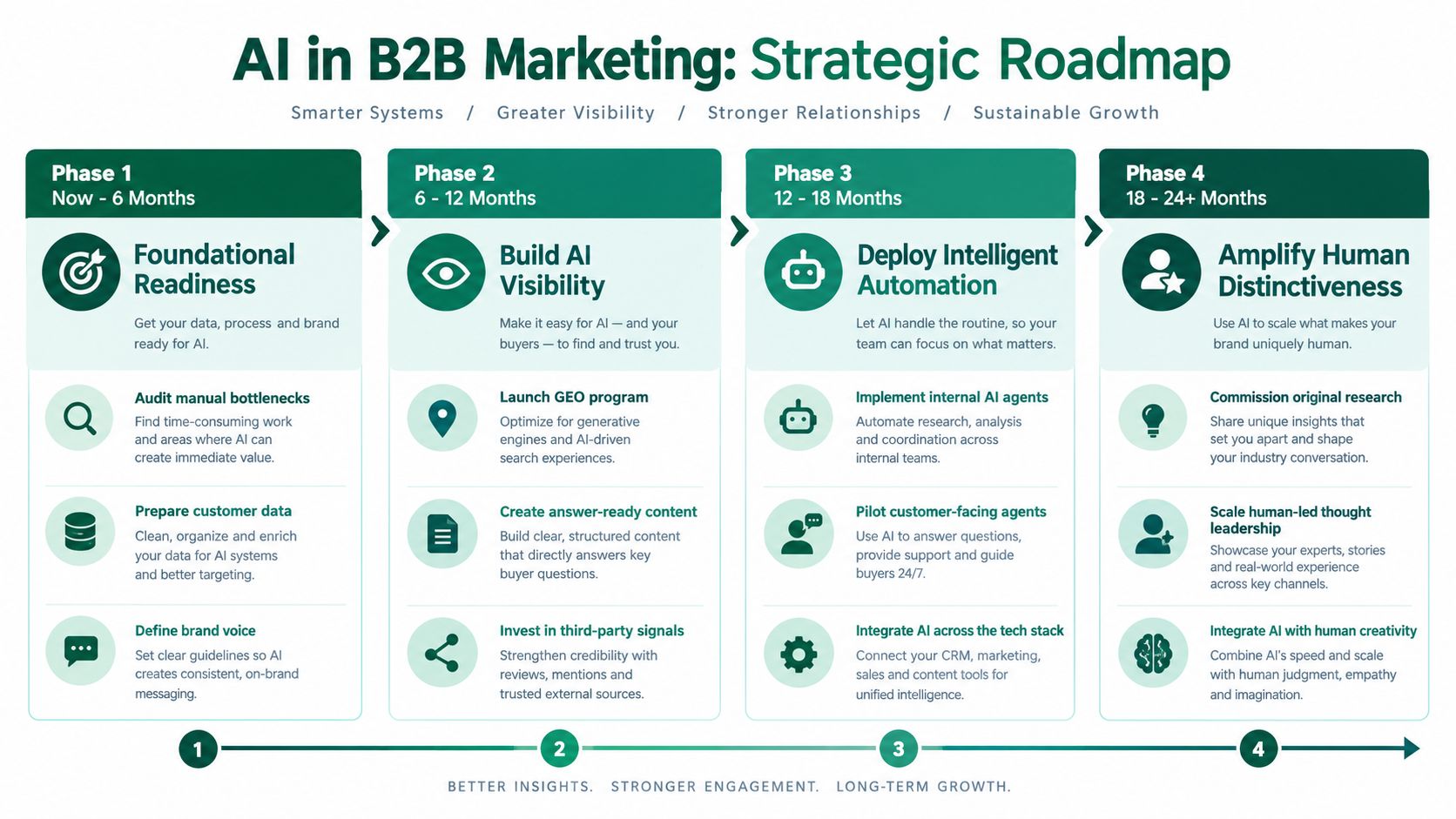
What B2B Marketers Should Prioritise Right Now
Use tools like Semrush's AIO, SE Ranking, or Brandi AI to understand how your brand currently appears in AI-generated answers across ChatGPT, Gemini, Perplexity, and Google AI Mode. This is your starting line for a GEO strategy.
Review your existing content assets against GEO criteria: information density, structured formats, clear answer blocks, and schema markup. Identify gaps and prioritise updates to your highest-traffic and most strategically important pages.
Rather than trying to automate everything at once, identify the one or two areas where an autonomous agent would create the most meaningful impact — whether that is intent-based ABM targeting, personalised outbound sequencing, or campaign performance optimisation — and build carefully, with human oversight.
Articulate clearly what your brand believes, what makes your perspective distinctive, and where you will commit to sustained original thought leadership. This is not just a positioning exercise — it is the foundation for AI-assisted content that stands out.
Commission a customer survey, publish a benchmark report, or systematise the research your team does daily into a shareable format. Original data is the highest-value content asset in an AI-saturated market.
The direction of travel is clear. AI in marketing is moving from tool to infrastructure, from assistant to agent, from experiment to operating system. The marketers who approach this shift with strategic clarity — rather than reactive adoption or reflexive resistance — will build advantages that compound over time.
The opportunity is real. The timeline is now.
This article was written by the Big Moves Marketing team. Big Moves Marketing is a B2B marketing consultancy offering fractional CMO services to SaaS startups and growth-stage B2B companies. Learn more at bigmoves.marketing.
Explore Big Moves Marketing services and resources:



%20-%20white.svg)